How to Tell If an Amber Tasbih Is Genuine: 7 Reliable Tests
How to tell if an amber tasbih is genuine: 7 reliable tests — salt water, UV light, friction-scent and weight — to separate natural and pressed amber from Bakelite and plastic.
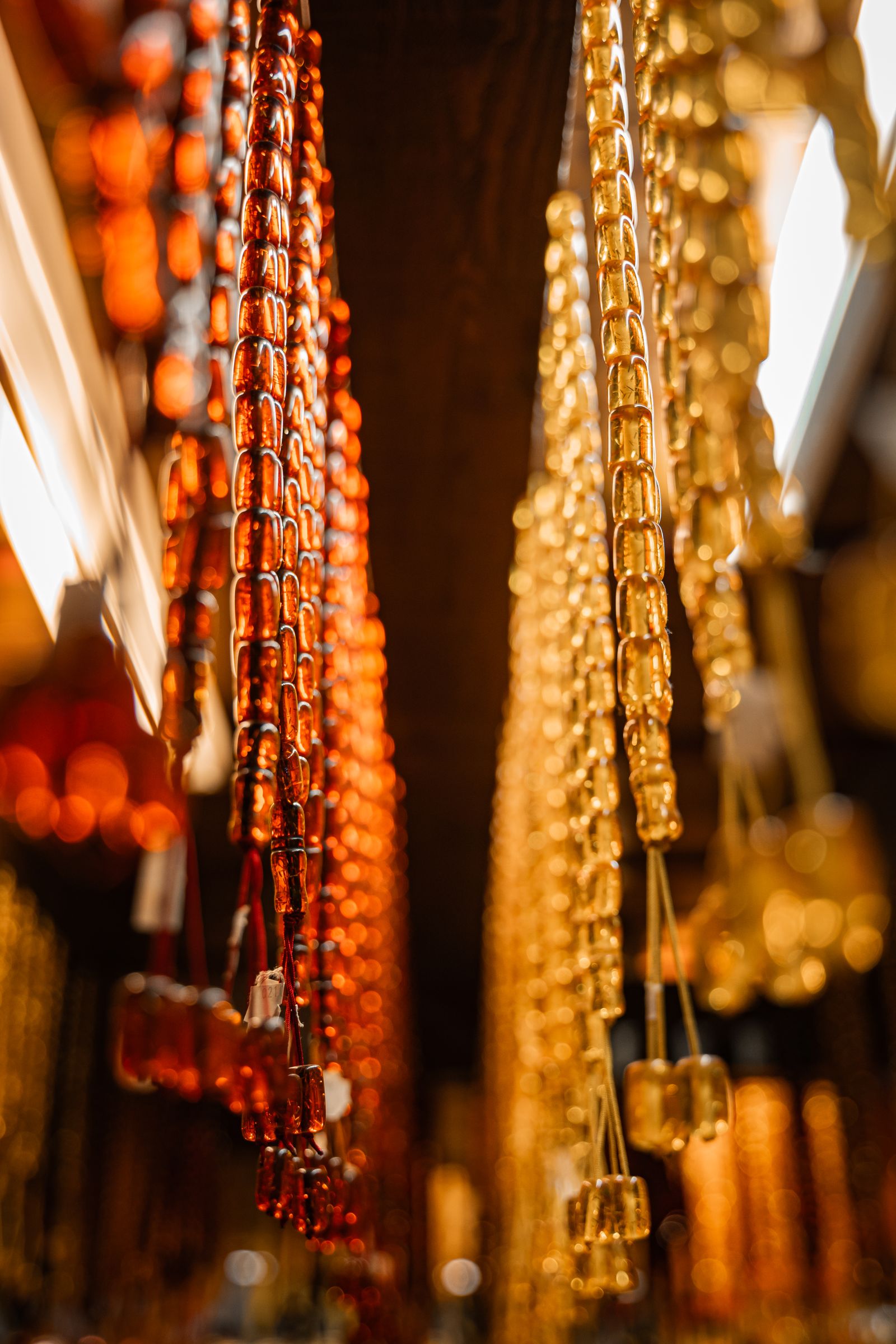
The first question almost every buyer asks about an amber tasbih is "is this real?" On the market, natural amber, pressed amber, Bakelite, phenolic resin, epoxy and plain plastic sit side by side, and behind a shop window they all look alike. To make matters worse, "genuine amber" means different things to different sellers: for some it covers only solid natural amber, for others it includes pressed beads made from natural amber. In this guide we explain how to tell a genuine amber tasbih from an imitation, which tests you can safely run at home, which tests can damage your prayer beads, and what to check at the moment of purchase.
First, the Definition: What Counts as "Genuine Amber"?
Amber is an organic material formed from tree resin that fossilised over millions of years. For a tasbih to be considered genuine amber, its beads must be made from that fossil resin. Two product groups fall under this heading:
- Natural (solid) amber: beads cut and shaped from a single block of amber. They contain air bubbles, cloudiness and natural veins; no two beads are ever identical.
- Pressed amber: a material produced by fusing small pieces of natural amber under heat and pressure. Because the raw material is still amber, it passes most organic tests while offering a more uniform colour and pattern. You can see examples in our pressed amber collection.
Pressed amber is not fake; it is processed amber. What is fake is selling beads made of phenolic resin, Bakelite, epoxy or acrylic — containing no amber at all — under the name "amber". The purpose of the tests below is precisely to draw that line.
1. Weight and Temperature: The Test That Starts the Moment You Pick It Up
Amber has a very low density (roughly 1.05–1.10 g/cm³). A standard 33-bead amber tasbih therefore feels lighter than you expect. Bakelite and phenolic resin are noticeably heavier; glass and natural stone are heavier still. Hold it next to a natural stone tasbih of the same size and the difference is immediate.
The second clue is temperature. Amber is a thermal insulator: it does not feel cold on first touch, sits at room temperature and warms quickly in the hand. Glass and stone feel cold at first contact and take time to warm up. Plastic can also feel warm, so this test alone is not conclusive, but it is useful for a first screening.
2. The Salt Water Test: The Most Reliable Method at Home
This is the best-known and safest amber test. Add roughly 7–8 teaspoons of salt to a glass of water and stir until the solution is saturated. Drop in a single bead (or the tail end without the imame) and observe:
- Natural and pressed amber float or hang suspended in the water.
- Bakelite, phenolic resin, glass and stone sink straight to the bottom.
- Some lightweight plastics may also float, which is why a floating bead should be confirmed with the next test.
Note: run this test on a single bead if possible, not on a complete tasbih with metal fittings, tassel or cord. Metal parts distort the result, and cord and tassel can be damaged when wet. Rinse and dry the bead afterwards.
3. The Friction and Scent Test
Amber builds up static electricity when rubbed; the word "electron" actually comes from the Greek word for amber. Rub a bead briskly against wool or your palm for 20–30 seconds, then hold it close to small scraps of paper. Genuine amber attracts the light pieces. The scent released by the warmed bead is also a key indicator: amber gives off a faint, warm, pine-like resin smell. Bakelite and phenolic resin release a sharp chemical odour, and acrylic smells of plastic.
This test does no harm to the beads and can even be carried out at the point of sale; many experienced buyers reach for it first.
4. The UV Light Test
A small UV torch is the amber buyer's most practical tool. In a dark room, natural amber fluoresces blue-green, milky white or pale yellow under UV light. Pressed amber glows as well, but more evenly, and the "flow" lines inside the bead become visible. Bakelite and phenolic resin either do not glow at all or return a dull, matte reflection. Glass does not glow.
The UV test also helps you distinguish pressed amber from solid amber: pressed beads reveal regular swirl patterns under the light.
5. The Hot Needle Test: Use with Care
This is the most widely known method and the most damaging. A heated needle is touched very briefly to a hidden spot on the bead, such as the inside of the imame hole. Amber releases a resin scent and the needle leaves only a faint mark; Bakelite gives off a sharp phenol smell and the needle does not penetrate. In plastic the needle sinks in as the material softens, and it smells of burnt plastic.
Only perform this test on your own tasbih and in a concealed spot. Doing it in a shop or on a seller's piece unquestionably lowers its value. In practice, when the four tests above are combined, the needle is rarely needed.
6. Visual Inspection: Bubbles, Veins and Uniformity
Pick up a magnifying glass. Natural amber shows irregular air bubbles, cloudiness and sometimes plant debris or insects; the colour is not evenly distributed within the bead. Pressed amber, viewed against the light, shows swirling flow lines and a more even, controlled colour gradient. In imitation material bubbles are either absent altogether or perfectly round and mechanical-looking, and the colour is almost identical throughout the bead.
Look at the beads in relation to one another as well: in natural amber, thirty-three beads can never be exactly the same shade. Extreme uniformity may point to a cast resin. Pressed amber, on the other hand, is deliberately produced to be uniform, so uniformity alone does not mean "fake" and must be read together with the other tests. In handmade tasbihs, millimetre differences in bead diameter are themselves a sign of the artisan's hand.
7. Colour Change and Patina over Time
Genuine amber oxidises on contact with air and light; over the years a pale honey tone deepens and reds turn richer. We covered this change in detail in our article Why Does Pressed Amber Change Colour?. If you are examining an older tasbih, patina, the extra sheen on the most-handled surfaces and depth of colour are strong indicators of authenticity. A tasbih used for years that is still as glass-clear and single-toned as on day one deserves suspicion.
Pressed Amber or Bakelite? The Most Commonly Confused Pair
The most frequent mix-up on the market is between pressed amber and Bakelite (phenolic resin), because both are produced in deep cherry, sour-cherry and reddish-brown tones. A practical checklist for telling them apart:
- Salt water: pressed amber floats, Bakelite sinks.
- UV: pressed amber glows, Bakelite does not.
- Weight: Bakelite is clearly heavier at the same size.
- Friction scent: amber smells of resin, Bakelite of phenol/chemicals.
- Sound: Bakelite beads click harder and sharper against each other; amber gives a softer, more muted sound.
Bakelite is a valuable, collectible material in its own right; the problem is Bakelite being sold as amber at amber prices. Likewise, techniques such as fire-pressed, rod-pressed and powder amber are all sub-types of pressed amber; seeing them in a product name tells you the material is amber-based.
Questions to Ask Before You Buy
Beyond the tests, the information a seller provides is itself an indicator. Do not hesitate to ask:
- Is this tasbih natural amber or pressed amber? (Walk away from a seller who cannot answer clearly.)
- If pressed, which technique was used: rod-pressed, fire-pressed, powder amber?
- What are the bead count, bead diameter and weight? If the weight is disproportionately high for the size, the material may not be amber.
- Is there care and repair support? What happens if the imame breaks or the cord snaps?
At Novatesbih, every tasbih that arrives from the artisan workshops we work with is inspected at our centre, and the material type and technique are stated clearly on each product page. Should any issue arise, our care and repair service is available. Dealers buying in bulk and businesses selling to the Gulf market will find detailed information on our wholesale page and in our wholesale buying guide.
Frequently Asked Questions
Does pressed amber count as genuine?
Yes. Pressed amber is made by fusing pieces of natural amber under heat and pressure; the raw material is amber. It is not as rare as solid amber, but it is not fake either.
How do I test an amber tasbih at home?
The safest sequence: weight and warmth in the hand, the salt water test, the friction-scent test and UV light. Use the hot needle test only on your own tasbih and only in a hidden spot.
Why is an amber tasbih so light?
Amber's density is very close to that of water, so it feels noticeably lighter than stone, glass or Bakelite beads of the same size. Lightness is not a flaw; it is the nature of the material.
Is a tasbih that does not glow under UV definitely fake?
Most likely it is not amber. However, some beads with a thick surface polish may fluoresce weakly; in that case confirm the result with the salt water and friction tests.
Conclusion
There is no single magic trick for recognising a genuine amber tasbih; but lightness, floating in salt water, a resin scent under friction, fluorescence under UV and the natural internal structure seen through a magnifier, taken together, give a very clear answer. Once you know these tests you can confidently assess both the tasbih you already own and the next one you plan to buy. For any question that comes up while choosing, have a look at our FAQ page or simply get in touch.