The Collector Value of Large-Bead Kuka Prayer Beads
Why kuka beads of 12 mm and above are scarce, which criteria set their collector value, which cuts and tones are sought after, and how to assess and preserve a piece. A guide for collectors and dealers.
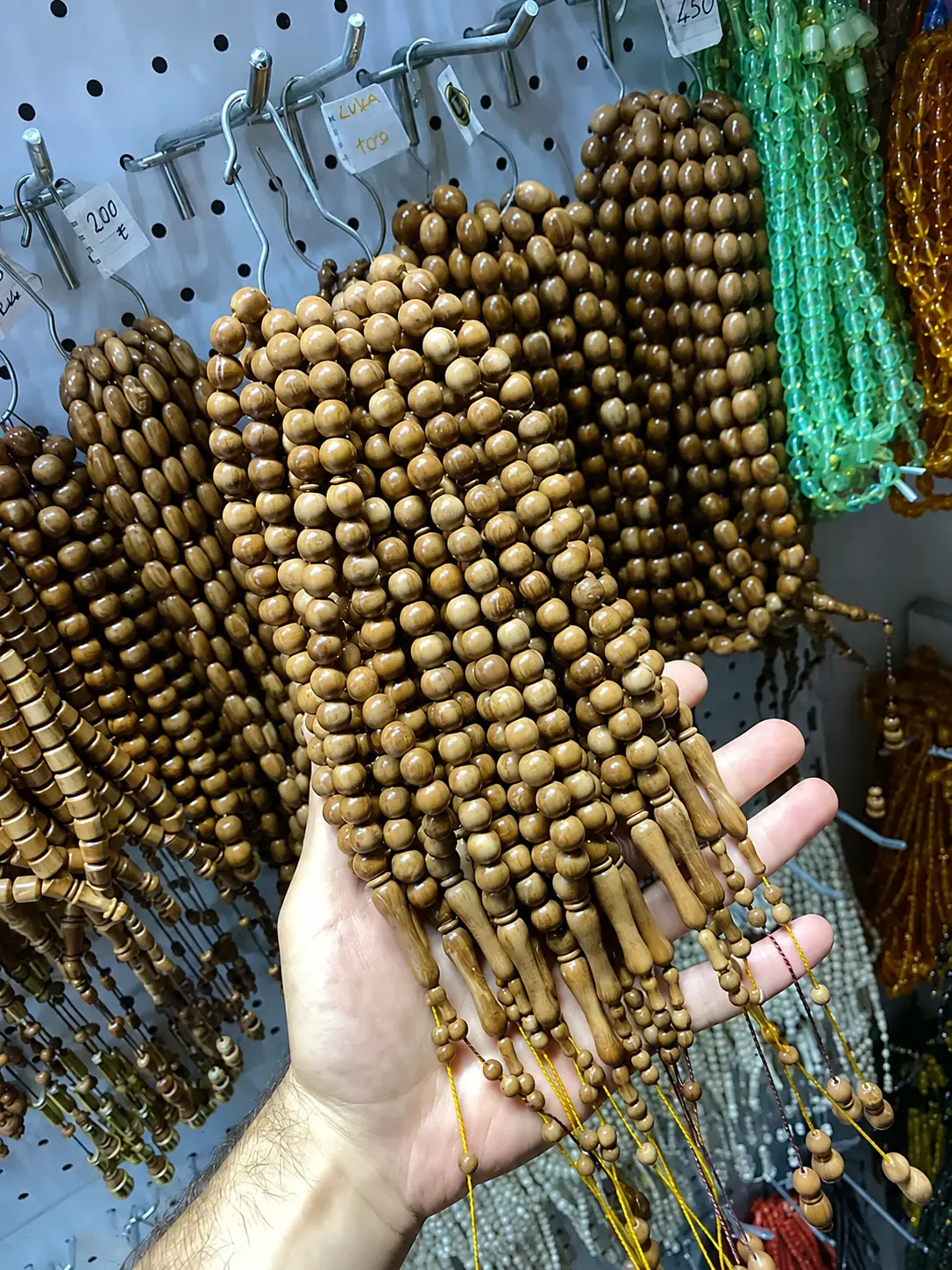
Among tesbih collectors, "large-bead kuka" is a category of its own. While standard 8–10 mm kuka strings sit on every shelf, a kuka tesbih strung from beads of 12 mm and above, with matching grain and flawless polish, can take years to find. In this article we look at why large-bead kuka is scarce, which criteria set its collector value, which cuts and tones are sought after, how to assess a piece, and how to preserve it.
What Does "Large Bead" Mean?
In bead-making, size is measured by the bead's widest diameter. The common kuka classification runs:
- Small: 6–7 mm; mostly 99-bead and women's strings.
- Standard: 8–10 mm; the backbone of daily use and wholesale.
- Large: 12–14 mm; the "hand-filling" tesbih, the start of the collector class.
- Extra large: 15 mm and above; rare, mostly 33-bead, mostly made to order.
For kuka's general properties and wholesale criteria see kuka wood prayer beads: wholesale and properties; here we focus on the large size only.
Why Is Large-Bead Kuka Scarce?
The raw-material limit
Kuka is the fruit stone of a palm species, and each stone has a limited workable diameter. A single stone yields several 8 mm beads, but to yield one flawless 13 mm bead the stone must be both large and free of veins and cracks. Collecting 33 large beads of equal diameter and colour means sifting through dozens of stones.
The waste rate
A large bead forgives no fault: a small grain fracture or an internal void drops the bead from the string. In master workshops the waste rate for 13 mm kuka rises to three or four times that of standard size. This raises both cost and waiting time.
The matching problem
As beads grow, colour and grain differences become more visible. A tone difference acceptable at standard size shows immediately on the shelf at 14 mm. Building a "matched string" in large size is therefore a separate skill; the uniformity principle described in the art of Ottoman-style prayer beads applies here in its strictest form.
Criteria That Set Collector Value
- Diameter and consistency: Every bead in the string is expected to fall within ±0.2 mm when measured with callipers. A single narrow or wide bead lowers value.
- Grain pattern: Fine, parallel, unbroken veins are most prized. Rare patterns known as "wave grain" and "eye grain" are sought out separately by collectors.
- Colour integrity: Beads must share one tone; a single coffee bead in a light tan string counts as a flaw.
- Cut: Sphere and olive lead in large size; barley cut above 12 mm is rare and valued accordingly.
- Imame and finial work: A proportioned imame turned from the same stone, suited to the large beads, completes the piece.
- Age and darkening: A large-bead kuka that has darkened evenly over the years is worth more than new production. How to read darkening is explained in why kuka prayer beads darken.
- Provenance and maker: Pieces whose workshop is known, that carry a master's mark or documentation, sit on a separate rung of the market.
Sought-After Cuts and Tones
Three types are most wanted in large-bead kuka:
- Large sphere, light tan: The grain reads best in this type; the Gulf market's first choice. Kuka Prayer Beads Tan No.09 is an example of this class.
- Large olive, coffee: Looks longer in the hand with good weight balance; the classic among collectors in Türkiye.
- Burnt kuka, large sphere: Heat-darkened, nearly black; rare and decorative.
For current large-bead options in our range, see the kuka wood prayer beads page.
How to Assess a Piece
When you take a large-bead kuka tesbih in hand, examine it in this order:
- Measure with callipers: Pick five beads at random; if the diameter spread exceeds 0.3 mm the string is not matched.
- Hold to the light: Grain should show in every bead, with no white spots or signs of internal voids.
- Lay on a flat surface: The string should lie without waviness; a raised bead means the hole is off-centre.
- Draw and listen: Large kuka beads give a full, deep "tock"; ringing or a hollow note points to a material problem.
- Weigh it: A 33-bead 13 mm kuka weighs roughly 35–45 grams. A markedly heavy string may be resin or stained wood. The safe-test principles in how to tell genuine amber can be adapted to kuka.
How to Preserve a Collector Piece
- Keep each piece in its own soft pouch so beads do not rub against each other.
- Store in a drawer away from light with low humidity.
- Wipe once a year with a soft cloth; a drop of almond oil is enough, more dulls the polish.
- Drawing collector pieces regularly does no harm; on the contrary, it advances darkening evenly and raises value.
- When the cord wears, do not restring it yourself; cord tension on large beads takes skill. Our repair service page is there for support.
Is There Investment Value?
Kuka does not see the speculative price swings of amber; its appreciation is slow but steady. A large, matched, aged piece can reach several times the price of new production over the years, but that comes from workmanship and rarity rather than the material itself. The right approach for a collector is not "look for a piece that will gain value" but "buy the piece that is flawless today"; a flawless piece holds its value on its own.
A Note for Dealers
Large-bead kuka is the shelf's "showcase piece": kept in small numbers, but it adds prestige to the display and supports standard-size sales. Two or three large pieces at a sales point are enough; they should be presented in a dedicated box with a separate label. For wholesale orders and minimum quantities see the wholesale prayer beads page, and for Gulf shipping terms the wholesale prayer bead export page. In corporate gifting, large-bead kuka is among the most chosen pieces for senior executives; details are on the corporate gifts page.
Large-Bead Kuka at Novatesbih
We set the standard and have production done by selected master workshops across Türkiye. For large-bead kuka, raw stone selection happens in the workshop, while diameter measurement and matching control happen at our centre in Zeytinburnu, Istanbul; beads outside ±0.2 mm do not enter the string. We are your single point of contact between you and the master. For special diameter or cut requests, reach us via the contact page.
Frequently Asked Questions
Is large-bead kuka suitable for daily use?
Yes; because kuka is light, even a 14 mm string does not tire the hand. Keep it away from keys and phones when carried in a pocket.
Large-bead kuka or large-bead amber?
They are different collector classes. Amber is pricier and more fragile; kuka is more accessible and more durable. Most collectors keep one of each.
Can a custom diameter be ordered?
Yes; production time for 15 mm and above is 4–6 weeks. See the FAQ for further questions.
Conclusion
Large-bead kuka is kuka at its most demanding and most valuable: scarce raw material, high waste, strict matching. A piece measured with callipers, with grain visible in the light, lying flat without waviness and giving a full sound, becomes the long-term anchor of a collection. Finding the right piece takes time; once found, it ages with you for years.