Turkish Fire Sıkma Models and Their Differences
What sets fire-pressed amber apart from the other pressed types, the five model families in the catalogue, what the colour range actually tells you, cut and bead size, selection criteria and care.
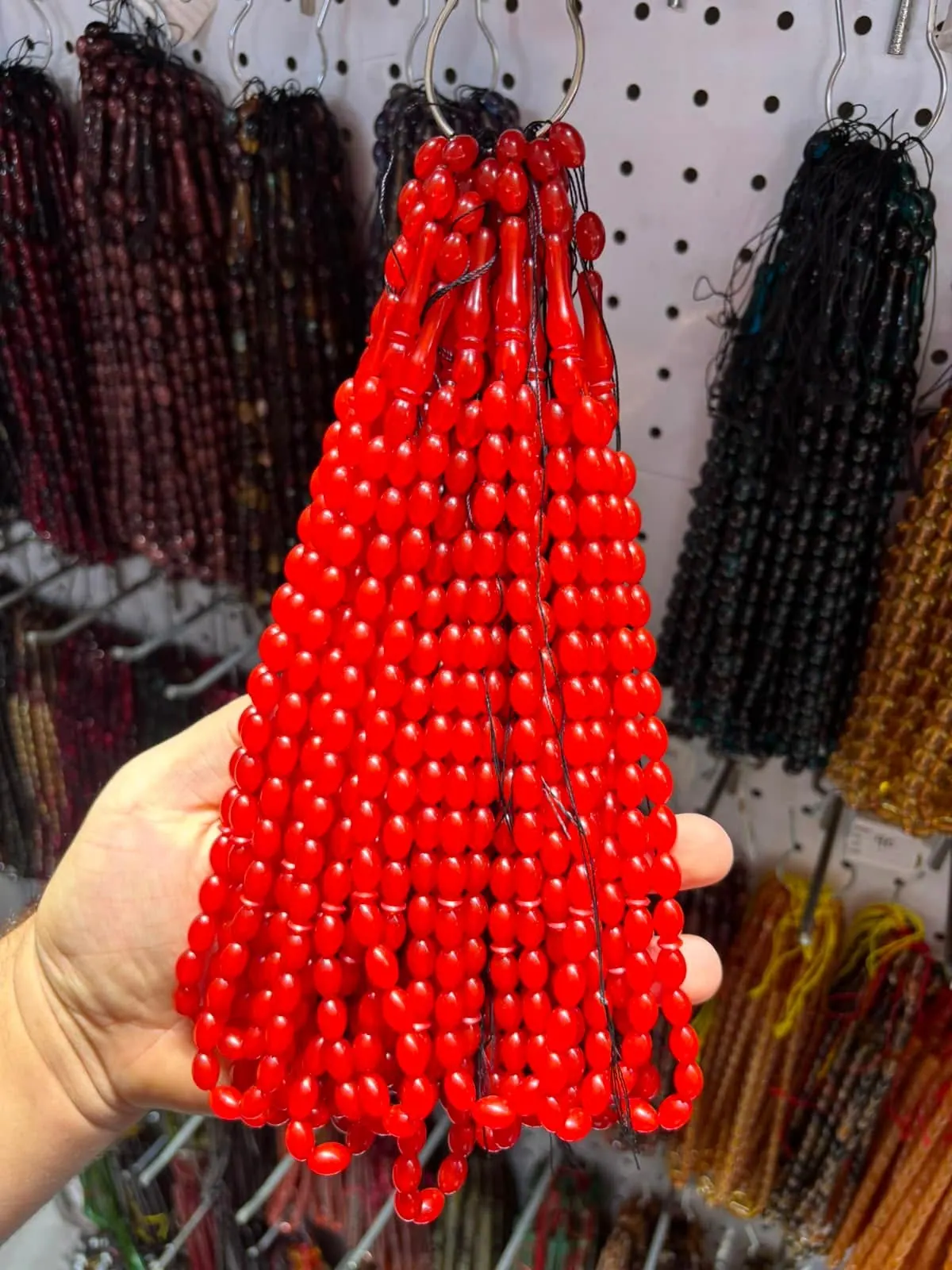
Say "pressed amber" and most people picture an even, honey-or-cherry coloured string. Fire amber is the liveliest branch of that family: the heat treatment leaves flame, vein and cloud patterns inside the bead, so no two beads are ever identical. Listed in our catalogue as fire-pressed amber, it is also our widest colour range. This article covers how fire amber is made, the model families it splits into, what the colour and cut differences actually mean, and what to check before you buy.
What Is Fire Amber?
Fire amber is not a separate raw material; it is a treatment applied to pressed amber. Small amber fragments are fused into a block under heat and pressure. A second, controlled heat treatment then creates micro-fractures and colour concentrations inside that block. When light travels through them, the bead shows the flame, spark or vein figure that gives the type its name.
The pattern is not printed on the surface — it sits inside the material. That is why it survives years of wear even after the polish dulls, and it is the most reliable way to recognise the type: hold a bead to the light and you will see the figure sitting at depth, not on the skin.
Fire-Pressed, Rod-Pressed and Powder-Pressed: The Differences
All three belong to the pressed amber family and start from the same raw material. The difference is in the processing.
- Rod-pressed: The block is cut into rods and turned. Colour is even, figure is minimal. The most durable and most classical group, and the closest to Ottoman proportions.
- Powder-pressed: Finely ground amber is pressed. The look is matte and opaque, passing little light. It feels warmer and quieter in the hand.
- Fire-pressed: The block receives an extra heat treatment that figures it. It is translucent, passes light, and carries a different pattern in every bead.
In practice: choose rod-pressed for a calm, uniform look, powder-pressed for a quiet matte texture, fire-pressed for a lively, colourful string. To test whether pressed amber is genuinely amber-based, the checks in how to tell if an amber tasbih is genuine still apply.
The Fire Amber Model Families in the Catalogue
The fire-pressed section is not one product but five model families. What separates them is not the material but the stringing and the finishing.
1. Classic Fire-Pressed Amber
A standard 33-bead string, plain imame, slim tail. This is where the figure reads most clearly, because nothing else competes for attention. It is the family most often chosen for daily use.
2. Fire-Pressed — Series 2
Series 2 runs a slightly larger bead diameter and leans on darker tones: black, dark honey, olive green and turquoise recur here. Flame figure reads with more contrast against a dark ground, and the string sits a little heavier in the hand than the classic line.
3. Fire-Pressed — Series 3
The widest colour spread lives here: honey, red, brick red, smoke grey, purple, green, turquoise, tan, brown. Series 3 was built for buyers who work by colour variety — anyone who wants a full display range from a single series usually picks from it.
4. Tasselled Fire-Pressed Amber
The same beads, finished with a classic kazaz tassel. Tassel colour is matched to the bead tone, and a heavy string never gets a thin tassel — it would throw off the balance. The detail looks minor but it decides how the piece hangs in the hand.
5. Fire-Pressed with Designer Tassel
A gift line where the tassel is longer, denser and often braided in two colours. Red, cherry, green and midnight blue dominate. This is the group most often asked about for corporate gifts.
What the Colour Range Tells You
In fire amber, colour comes from the treatment rather than from a natural tone of the raw material. The range is therefore wide, and colour is not a quality signal. The quality signal is how well the beads within one string match each other.
- Honey, light honey, dark honey, amber orange: Closest to the classical amber image; the most requested group in the Gulf.
- Red, cherry, brick red, fuchsia, dusty rose: Where the flame figure looks most dramatic.
- Green, dark green, olive, turquoise: Clearly rising in Turkish domestic retail in recent years.
- Black, smoke grey, brown, tan, ivory, purple, blue, midnight blue: Quieter tones that work as an accessory.
Some products have no colour recorded; those are the photographs where several colour options appear together. If colour change in general is the question, why does pressed amber change colour covers it in detail.
Cut and Bead Size
The common cuts are barley (arpa), capsule and round. The barley cut is elongated with slightly tapered ends; because light travels the longest path through it, it shows the figure best. The capsule cut is more cylindrical and runs faster through the fingers. The round cut breaks the figure into segments and reads as busier.
Bead diameter is usually 8–12 mm. Small beads are light and quiet and do not tire the fingers over a long dhikr. Large beads are showier and give a fuller sound as they strike. Size affects price directly — see factors that determine wholesale amber tasbih prices.
What to Check When Choosing
- Pattern balance: Every bead will differ, and that is normal. What you want is similar pattern density. One bead full of flame next to a plain one makes the string look accidental.
- Matching: Beads should agree in diameter and length. Lay the string on a flat surface; any waviness means the sizes do not hold.
- Drill axis: The hole must run through the centre of the bead, or the beads wobble as the string is pulled.
- Polish: Smooth, but not plastic-bright. Fire amber gives a soft, deep shine.
- Imame match: Same material and same tone as the beads, usually cut one size larger.
- Sound: Beads should give a short, full knock. A glassy ring means a different material.
These criteria come out of the handmade prayer bead tradition and continue directly from the standards described in the art of Ottoman-style amber prayer beads.
Care
Fire amber has already been through heat, and it does not welcome a second exposure. A few simple rules are enough:
- Do not leave it in direct sun or on a car dashboard.
- Keep it away from perfume, cologne and alcohol-based cleaners; the polish goes dull.
- Clean with a dry or barely damp soft cloth and dry it at once.
- Store it in a pouch, away from light, when not in use.
When the cord loosens or the tassel wears, do not repair it yourself — restringing is skilled work. Reach us through the repair service page.
Fire Amber in Wholesale
Fire-pressed amber makes a display easy to build: close to twenty colours come out of one material, so a full shelf range can be covered from a single category. Within Turkey we sell both wholesale and retail; abroad we ship wholesale only. See the wholesale page for terms and wholesale prayer bead export for country-level detail. Models available from stock are listed on the in stock page.
We set the standard, production is carried out by the selected master workshops we work with across Turkey, and every batch passes a final inspection at our Zeytinburnu premises in Istanbul. We are the single link between you and the maker.
Frequently Asked Questions
Is fire amber real amber?
It is amber-based: genuine amber fragments fused under heat and pressure. It is not single-piece natural amber and is not sold as such.
Why does every bead look different?
The figure forms inside the material during heat treatment. It is controlled but not exactly repeatable. That is the definition of the type, not a flaw.
Which model suits a gift?
A 33-bead barley-cut designer-tassel string in dark honey or cherry is the safest choice.
How does fire amber differ from tortoiseshell-pattern?
Fire amber is translucent and its figure is read through light; tortoiseshell-pattern is more opaque, with a layered, shell-like surface. For detail see blood bağa prayer bead models.
Conclusion
With fire amber, the difference between models is not the material but the stringing and the finish. The classic line shows the figure most clearly, Series 2 runs dark and heavy, Series 3 works by colour variety, and the tasselled lines carry the gift side. Whichever family you pick, the checks are the same: matched beads, a centred drill, a balanced tassel and a full sound. Browse the collection on the fire-pressed amber page, and bring questions to contact or the FAQ.